Independent sourcing note: Coconut Bowls Supplier is an independent B2B sourcing desk — we are not a manufacturer, exporter of record, or freight forwarder. We curate verified Indonesian coconut-bowl makers (Bali & Java) and route your RFQ to a vetted production partner. MOQs, FOB prices, and lead times shown are indicative ranges [VERIFY by quote]. Food-contact compliance (e.g. FDA / LFGB) for US/EU import must be confirmed with the supplier and your own customs broker — this is general trade information, not legal, customs, or compliance advice. We may earn a sourcing commission on referred orders (referral disclosure).
Coconut bowls versus bamboo bowls is one of the more common material questions buyers ask before placing a first import order, and the honest answer is not a single winner. Coconut shell bowls, bamboo bowls, and wooden bowls (typically acacia or teak) are three distinct materials with different structural properties, different size ceilings, different finish requirements, and different supply-chain realities. The right choice depends on your retail channel, your customer’s use-case, and what your supplier can actually document about finish and food safety — not on which material makes the best marketing headline.
This page compares all three on the axes that matter most to a reseller or importer: density and durability, heat and liquid limits, food-safety and finish considerations, size and weight constraints, aesthetic consistency, eco and end-of-life claims, and retail use-case fit. Where the comparison is grounded in material science or well-established production practice, I say so. Where no audited comparative dataset exists — and for most of these materials, none does — I say that too. Verify finish and food-safety compliance per supplier before making claims to your own customers.
Material Basics: What Each Bowl Is Actually Made From
Before the comparison, a brief grounding on what these materials are, because “bamboo bowl” in particular covers very different products depending on the manufacturer.
Coconut Shell Bowls
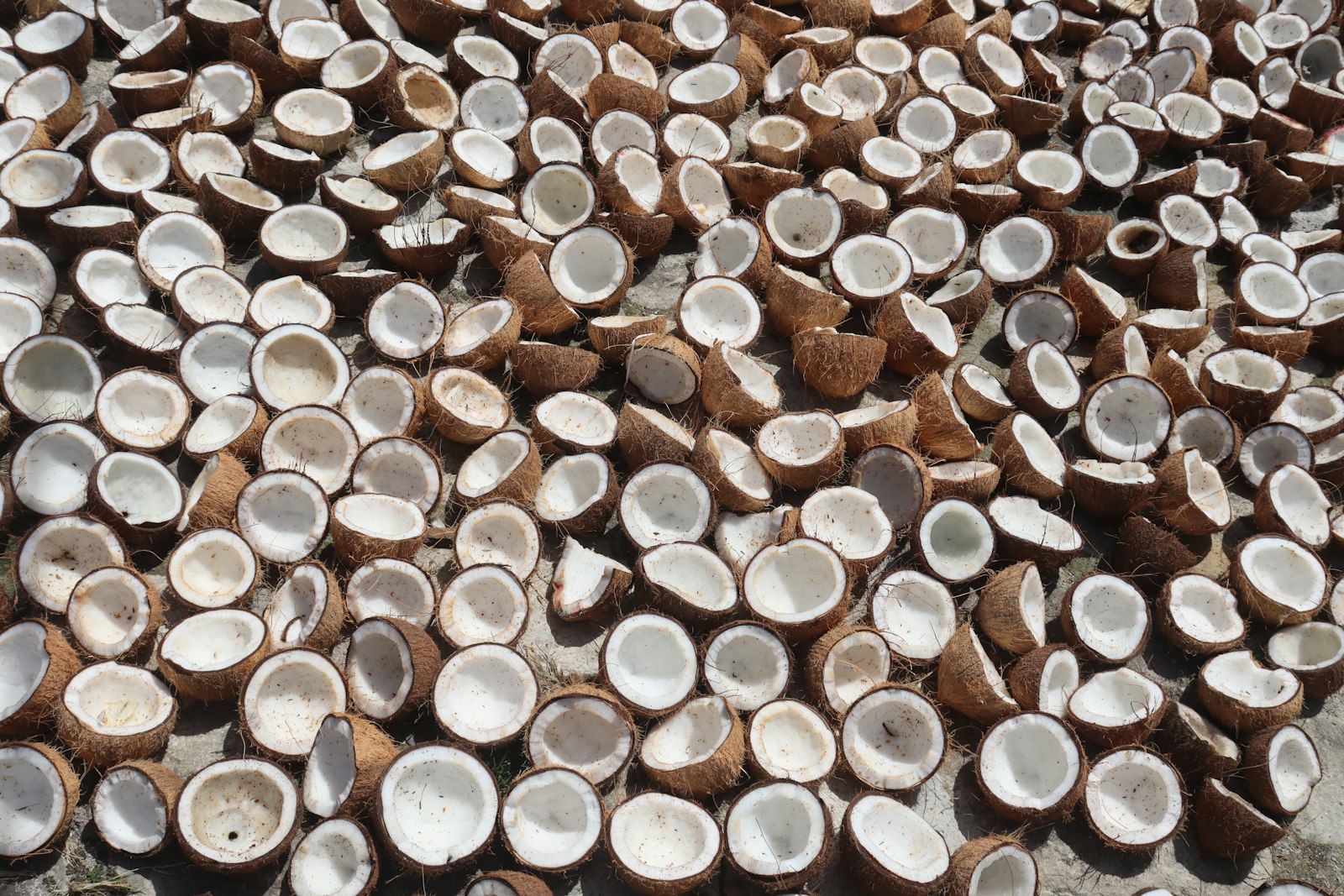
A coconut bowl is made from the hard endocarp — the dense inner shell — of a fully mature brown coconut. The shell has densified over roughly twelve months on the palm. By harvest time it is a genuinely hard, naturally glossy material: harder than most softwoods, closer in density and feel to a hardwood like teak. The bowl is literally the halved coconut shell, cleaned, sanded progressively from around 80–120 grit through to 320–400 grit, and finished with either a food-grade penetrating oil or a film coating. No adhesives, no pressed fibres, no binding agents — it is a single piece of natural shell.
That single-piece structure is the source of both the material’s main strength and its main constraint. Each shell is unique in diameter, colour, wall thickness, and grain pattern. That uniqueness is the selling point. It is also what makes lot-to-lot consistency a QC challenge.
Bamboo Bowls
Here the word “bamboo” hides a significant product split. A bamboo bowl is either:
- Turned solid bamboo: a large-diameter bamboo culm (stem) that is lathe-turned into a bowl shape, similar in concept to a wooden turned bowl. Less common because large-diameter bamboo is rarer and more difficult to source at consistent diameters.
- Pressed bamboo composite: shredded bamboo fibres or strips bonded with a resin (often melamine or urea-formaldehyde-based) under heat and pressure, then moulded into a bowl. This is the majority of what is sold as “bamboo bowls” in the gift, restaurant-supply, and eco-retail sectors. It can be moulded to consistent shapes and sizes, and it is harder and more uniform than natural wood. However, the binding resin is the food-safety variable — melamine-formaldehyde composites have documented migration concerns at elevated temperatures.
The distinction matters for almost every axis in this comparison. When buyers ask about coconut bowls vs bamboo for hot food, the answer is different depending on which bamboo product they mean.
Wooden Bowls
Wooden bowls in the import market are typically turned from hardwood species: acacia is the most common in the price-accessible wholesale tier, teak for premium positioning, mango and monkey-pod in some tropical export clusters. These are lathe-turned from solid timber, finished with oil, lacquer, or a combination. They are not constrained by the size limits that shell geometry imposes on coconut bowls — a skilled turner can produce a 30 cm acacia salad bowl from the same basic process, just at a larger scale.
Durability and Density
Mature coconut shell is hard. People who handle it regularly describe it as closer to a nut-shell than to wood, and that is accurate — it is botanically a drupe, and the endocarp is dense enough that cheap cutting tools blunt on it. In practice, the wall of a finished coconut bowl is typically 4 to 8 mm thick at the sides, thinning toward the rim. That rim thinness is the structural weak point: it is where cracks originate under impact or thermal shock.
Solid-turned bamboo of comparable wall thickness is also hard and impact-resistant. Pressed-bamboo composite is harder still in surface terms because the binding resin stiffens the matrix, but it is more brittle — it can chip or crack in a way that reveals the composite interior, which is not aesthetic and can expose resin.
Hardwood bowls (acacia, teak) in the 15–25 mm wall thickness typical of a turned salad or serving bowl are more impact-resistant than a coconut shell simply because of mass. A heavy acacia salad bowl dropped on a tiled floor may scratch; a coconut bowl dropped from the same height is more likely to chip or crack at the rim. This is not a fundamental material weakness of coconut shell — it is a geometry constraint. The shell is thinner by nature.
For coconut bowl vs wooden bowl durability in a smoothie-cafe or daily-use context: with proper care (hand-wash only, no soaking, no dishwasher, re-oiling as needed for oil-finished bowls), a well-made coconut bowl is durable enough for years of regular use. The failure modes in practice are thermal shock and dishwasher exposure, not inherent material weakness.
Heat and Liquid Limits: The Honest Version
None of these materials — coconut shell, bamboo, or wood — is truly suited to very hot food or to soaking in liquid. That is the single most important thing to say clearly, and it is the thing most marketing copy around all three avoids saying.
| Material | Hot food | Soaking | Dishwasher | Microwave |
|---|---|---|---|---|
| Coconut shell | Warm food only — no boiling liquid, thermal shock cracks rim | No — absorbs moisture, warps, finish degrades | No — heat + soaking + detergent cracks and warps | No — localized heating cracks shell |
| Solid-turned bamboo | Warm food acceptable — boiling liquid risks cracking at joins or grain | No — splits along culm grain | No | No |
| Pressed bamboo composite | Manufacturer-dependent — melamine composite NOT safe for hot food; some claim higher-temp ratings [VERIFY per product] | Generally more resistant than natural materials, but not soak-safe | Some composites are rated dishwasher-safe [VERIFY per product] | No for melamine composite — formaldehyde migration risk at high temperature |
| Hardwood (acacia, teak) | Warm food acceptable — boiling liquid risks cracking or finish damage | No — warps, cracks, finish delaminates | No | No |
The thermal shock point applies specifically to coconut shell and wood: filling a cold bowl with near-boiling liquid creates a rapid temperature differential across the shell wall that the material cannot accommodate without stress cracking. This is not a reason to avoid the product — smoothie bowls, acai bowls, and overnight oats are served at room temperature or cold, and that is precisely the use-case these bowls are designed for. It does mean that care instructions need to be explicit, and that any retail positioning around hot-food service should be qualified carefully.
The melamine composite point deserves more attention. Pressed bamboo products using melamine-formaldehyde binders are a documented food-safety concern at elevated temperatures: formaldehyde and melamine can migrate into food above approximately 70°C. European food-safety authorities (EFSA) have published opinions on melamine migration from kitchenware. Some pressed-bamboo products are mislabelled or unverified on this point. If you are sourcing “bamboo bowls” and the product is composite, verify the binder chemistry and ask for migration test results — not a BPA-free badge, which says nothing about melamine. This is information, not legal or food-safety advice; confirm with the relevant authority and your own consultant.
Food Safety and Finish Considerations
All three materials require a finish to function as a food-contact vessel, and the finish — not the base material — is where the food-safety question actually lives for regulators.
For coconut shell and solid wood, the situation is structurally similar: the shell or wood itself is not regulated at the material level, but the coating must comply with the relevant food-contact materials framework in the destination market. In the US that means 21 CFR; in the EU it means Regulation (EC) 1935/2004, and for plastic-film coatings also EU 10/2011. Germany’s LFGB adds sensory testing (odor and taste). The marketing term “food-grade lacquer” is not a compliance claim — generic hardware lacquer is not food-safe, and only a film coating documented as food-contact compliant by an accredited laboratory meets the requirement.
Oil-only finishes (refined coconut oil, food-grade mineral oil) on coconut shell or wood are simpler: the oils themselves are food substances and are generally accepted as food-contact safe when uncontaminated. The trade-off is durability: oil finishes are not waterproof, need periodic re-oiling, and are stripped by strong detergents.
For pressed-bamboo composite, the finish question is layered on top of the binder question. Even if the surface lacquer is compliant, the composite substrate must also be verified for migration. This is why bamboo composite has a more complex food-safety documentation path than natural shell or solid wood.
A practical note for importers: our food-safe finish and certifications guide walks through the regulatory frameworks, what lab reports to request, and what the LFGB benchmark covers. The same questions — coating data sheet, migration test report from an accredited laboratory, Declaration of Compliance — apply regardless of whether the material is shell, solid wood, or bamboo.
Size and Weight: The Geometry Constraint
This is the axis where coconut shell is most obviously constrained and where buyers sometimes get caught out by expectations set by marketing photographs.
Coconut shell bowl diameter is determined by the coconut itself. The usable diameter of a halved mature coconut shell is typically approximately 12 to 14 cm, with wall height of roughly 5 to 8 cm depending on where the equatorial cut falls. This is the right size for an individual smoothie bowl, an acai bowl, a single serving of overnight oats, or a small snack portion. It is not a salad bowl, not a pasta bowl for larger portions, and not suitable for serving pieces that need to hold food for a table. You cannot make a 30 cm coconut bowl — the coconut does not grow that large at production scale.
This is a supply-chain reality, not a defect. It defines the use-case. Buyers sourcing coconut bowls for smoothie or acai cafes, individual-serving applications, gift sets, or subscription-box eco products are working within that geometry and it suits them. Buyers who need a large serving or salad vessel are looking at wood, not shell.
Weight is the secondary size consideration. A coconut shell bowl is light enough to hold comfortably in one hand while eating, which matters for cafe and outdoor use. A 25 cm acacia salad bowl is a serving piece that stays on the table. These are different products addressing different needs.
Bamboo, in both turned and composite forms, can be produced in a wider range of diameters because the raw material is not constrained by natural geometry in the same way. Composite bamboo can be moulded to very consistent shapes and sizes across a production run. This is a genuine advantage for buyers who need size consistency across a large order — coconut shell bowls will have natural diameter variation of several millimetres across a batch, which most buyers find acceptable but which occasionally surprises buyers expecting the uniformity of a manufactured vessel.
Aesthetic Consistency vs Uniqueness
Every coconut shell bowl is different. The grain pattern, colour variation from dark espresso brown to lighter honey tones, the presence or absence of the shell’s natural striation lines, and the exact diameter and rim profile all vary from piece to piece. For most buyers in the coconut bowl category, this is the product’s appeal: genuine handmade character that a plastic or composite bowl cannot replicate. Each bowl is identifiably a piece of a natural object.
That uniqueness is also a consistency challenge for retail. If your SKU requires that every bowl look nearly identical in the product image, coconut shell will create ongoing photography and customer expectation issues. Buyers who build their brand around natural variation — and many eco and gifting brands actively do — can make the variation a feature. Buyers who need tight visual consistency are better served by composite bamboo or a consistent-grain hardwood species.
Hardwood bowls occupy a middle ground. Turned acacia or teak has grain variation, but the variation is in colour and grain pattern within a more predictable range than coconut shell. Acacia in particular has a warm, consistent honey-to-brown colour range that photographs reliably.
Eco and End-of-Life Claims: Which Is Better?
The short answer to which is better, coconut or bamboo bowls eco: it depends on the finish, the supply chain, and what specific claim you are making — and all three materials have a more complicated eco story than their marketing suggests.
Coconut Shell
The “upcycled agricultural byproduct” claim for coconut shell is plausible — Indonesia processes roughly 17 million metric tonnes of coconuts annually (FAO data, 2022–2024, making Indonesia the world’s largest coconut producer), and the shells are a genuine by-product of that processing. Shells that become bowls would otherwise be burned as fuel or composted. The claim is not verifiable from marketing language alone; it requires feedstock documentation from the specific supplier. Ask for it.
Biodegradability and compostability hold for bowls finished with food-grade oil only — the shell itself is a natural material that will break down. Bowls coated with lacquer, PU, or other film finishes lose this property because the synthetic coating does not biodegrade at the same rate or in the same conditions as the shell. “Plastic-free” requires checking not just the bowl finish but the packaging: the polybag, tape, and labels commonly used in export packing are plastic. Our sustainability guide covers each claim individually with the evidence base and documentation to request.
Bamboo
Bamboo is a fast-growing grass — the fastest-growing plant on earth in some species — and the raw material argument is genuinely strong: bamboo sequesters carbon, requires no pesticides at scale, and regrows without replanting. Solid-turned bamboo carries these properties through to the finished product with minimal processing.
Pressed-bamboo composite undermines much of this story. The binding resin (typically melamine-formaldehyde or urea-formaldehyde) is a petrochemical product. A bowl that is 60% bamboo fibre and 40% melamine resin is not meaningfully “natural” in the way the marketing suggests, and it is not biodegradable or compostable. The “bamboo” category carries the fast-growing-grass narrative but often delivers a composite product whose end-of-life profile is closer to plastic than to wood.
Wood
Hardwood bowls from sustainably managed sources (FSC certification is the standard documentation to request) have a defensible eco story. The concern is sourcing: acacia is a plantation species with reasonable availability, but teak from non-certified sources has deforestation associations. Oil-finished solid wood is fully biodegradable at end of life. Lacquer-coated wood is not. The same finish logic that applies to coconut shell applies here.
Retail Use-Case Mapping: Which Material Fits Where
Rather than declaring a winner, the more useful frame for a buyer is: which material fits which channel?
- Smoothie and acai cafes
- Coconut shell is the dominant choice, and for good reason. The 12–14 cm diameter is the right portion size, the natural aesthetic fits the cafe visual language, the weight is comfortable in-hand, and the price point allows for per-use economics that make sense. The critical care requirement — hand-wash only, no soaking, no dishwasher — needs to be built into the operational protocol. Cafes that run dishwashers on the line need to solve that operationally before committing to coconut bowls for service. For coconut bowls for smoothie and acai cafes, this is the clearest fit-for-purpose material in the three-way comparison.
- Gift sets and eco ecommerce
- Again coconut shell, particularly bowl-plus-spoon gift sets. The natural uniqueness of each piece is a feature in gifting — it photographs well, carries the story of individual handcraft, and is price-accessible enough at the $1.50–3.50 per set wholesale range (supplier-reported, confirm by pro-forma invoice) to support healthy retail margins. Custom laser engraving on the shell exterior is common for branded gifting. Our spoons and sets guide covers the set configurations and pricing range.
- Lightweight serving and lunchbox applications
- Bamboo, particularly solid-turned bamboo, suits buyers who want something lighter than a full hardwood piece and in a broader range of sizes. The portability argument is stronger for bamboo than for either shell or heavy hardwood.
- Salad bowls, serving pieces, and larger tabletop items
- Hardwood (acacia, teak, mango) for any application where size matters. A 25–30 cm acacia salad bowl is a different product category than a 12 cm coconut shell bowl. Wooden bowls also have more design latitude: a turner can make a bowl any diameter the timber blank allows.
- Zero-waste retail and refill stores
- Oil-finished coconut shell is probably the most defensible material for this positioning: byproduct origin claim is plausible, oil finish is biodegradable, no synthetic coatings, and the product story is coherent. Verify the feedstock and finish with the supplier and request the documentation.
If you are building a multi-SKU range, there is no reason these materials cannot coexist in the same catalogue. Many eco-lifestyle brands carry both coconut bowls for individual smoothie-bowl use and wooden salad servers for table service — the materials are complementary rather than competitive once the use-case is defined.
For sourcing help across any of these materials — including a curated shortlist of verified Indonesian producers who can document finish compliance, drying protocols, and QC tolerances — reach us on WhatsApp 6281139414563 or at our enquiry form. No one can pay us to change what we publish here; if you proceed with a partner we refer, they may pay us a referral fee at no extra cost to you.
Comparison Summary
| Axis | Coconut Shell | Bamboo (solid-turned) | Bamboo (composite) | Hardwood (acacia/teak) |
|---|---|---|---|---|
| Typical diameter | ~12–14 cm (geometry-limited) | Variable, up to ~20 cm+ | Moulded to spec | Any size — 15–35 cm common |
| Durability under normal use | Good if cared for; rim is weakest point | Good | Hard surface; can chip/crack | Very good; mass absorbs impact |
| Hot food | No boiling liquid; thermal shock risk | Warm food OK; no boiling | Verify per product; melamine composites NOT for hot food | Warm food OK; no boiling |
| Dishwasher | No | No | Some composites claim yes [VERIFY] | No |
| Food-safety path | Finish must be compliant (21 CFR/EU/LFGB); oil-only simpler | Same as coconut/wood for solid; finish is the variable | Binder + finish must both be compliant; more complex | Same as coconut shell for solid wood |
| Aesthetic consistency | Natural variation; each piece unique | Moderate variation | High consistency; moulded | Moderate; grain varies by species |
| Biodegradable (oil finish) | Yes — with food-grade oil only | Yes — with oil finish | No — resin binder | Yes — with oil finish |
| Best retail fit | Smoothie/acai cafes, gift sets, eco ecommerce | Lightweight serving, lunchware | Restaurant supply, canteen, institutional | Salad/serving pieces, premium kitchenware |
Frequently Asked Questions
Are coconut bowls better than bamboo bowls for daily cafe use?
For smoothie and acai cafes specifically, coconut shell is the more widely used choice, and it suits the application well: the 12–14 cm diameter is the right portion size, the natural aesthetic is a brand asset, and the unit cost at wholesale (roughly $0.50–1.50 for plain bowls, supplier-reported) supports per-cover economics. The firm requirement is hand-washing only — no dishwasher, no soaking. Cafes that run a commercial dishwasher on their bowl service need to build hand-washing into the workflow before adopting coconut bowls. Bamboo composite is more commonly used in institutional food service where dishwasher ratings matter, but carries its own food-safety documentation requirements, particularly for hot food and melamine binders.
Can you put hot food in coconut bowls?
Warm food, yes. Boiling or near-boiling liquid, no. Filling a cold coconut shell bowl with very hot food or liquid creates a thermal shock — the rapid temperature differential across the shell wall causes stress that concentrates at the rim, the thinnest point, and can crack it. This applies to solid wood as well. The same care instruction applies to both: serve foods at room temperature or lightly warm, not boiling. None of these materials — coconut shell, solid bamboo, or hardwood — are microwave-safe. Pressed-bamboo composite with melamine binders should not be used for hot food due to documented migration concerns at elevated temperatures.
Which is more eco-friendly: coconut or bamboo bowls?
For solid, naturally finished versions of both materials, the eco story is broadly similar and both are defensible: byproduct coconut shell with food-grade oil is biodegradable and made from an agricultural waste stream; solid-turned bamboo from a responsibly managed source is biodegradable and from the fastest-growing plant material available. The comparison breaks down entirely for pressed-bamboo composite: the melamine or urea-formaldehyde binder is a petrochemical product, and the composite is not biodegradable. If eco positioning is central to your brand, verify the specific product type, the finish chemistry, and the feedstock origin with your supplier, and request documentation rather than accepting a marketing badge. Our sustainability guide covers the defensible claims for each material.
Why are coconut bowls limited to a small size?
Because the bowl is literally half a coconut. The diameter of the finished bowl is set by the diameter of the coconut at harvest, which for mature production-grade coconuts is typically in the 12 to 14 cm range. There is no manufacturing process that makes a coconut shell larger — the geometry is fixed by the fruit. This makes coconut shell inherently an individual-serving format: a smoothie bowl, an acai bowl, a small cereal or snack portion. Buyers who need larger serving vessels — salad bowls, pasta bowls, sharing plates — will find that hardwood turned bowls are the practical alternative, sized as large as the timber blank allows.
Are any of these materials dishwasher or microwave safe?
For coconut shell and solid wood and solid bamboo: no, none are dishwasher or microwave safe. Dishwasher temperatures of 60–70°C combined with prolonged soaking and alkaline detergent will crack, warp, and delaminate any natural-material bowl regardless of the finish. Microwave heating is similarly dangerous: the localized heating it creates inside a bowl causes thermal gradients the shell or wood wall cannot accommodate without stress cracking. All three natural materials are hand-wash only, no soaking, no strong detergents. For pressed-bamboo composite, some products claim dishwasher ratings — verify this per specific product with the supplier’s documentation. No melamine composite product should be microwaved.