Independent sourcing note: Coconut Bowls Supplier is an independent B2B sourcing desk — we are not a manufacturer, exporter of record, or freight forwarder. We curate verified Indonesian coconut-bowl makers (Bali & Java) and route your RFQ to a vetted production partner. MOQs, FOB prices, and lead times shown are indicative ranges [VERIFY by quote]. Food-contact compliance (e.g. FDA / LFGB) for US/EU import must be confirmed with the supplier and your own customs broker — this is general trade information, not legal, customs, or compliance advice. We may earn a sourcing commission on referred orders (referral disclosure).
Coconut spoons and accessories sourcing covers the individual cutlery and companion items that pair with coconut shell bowls — specifically coconut-shell spoons, coconut-wood forks and spoons, salad and serving servers, bamboo straws, and small decorative accessories — each bought separately from the bowl itself rather than as a pre-assembled set. That distinction from a bowl-and-spoon bundle is the starting point for this guide. The bundle economics are covered in the coconut bowl and spoon set wholesale page. Here we focus on the individual accessory lines: what they are made from, how the making process differs from the bowl, why each item has its own finish and food-safety requirements, what drives MOQ on accessories versus bowls, and how different buyer types — cafes, gift retailers, eco ecommerce brands — fit different items into their programmes.
One thing to establish at the outset. We are an independent sourcing desk. We research this category, curate verified makers, and route qualified RFQs to a vetted production partner in Indonesia — a referral relationship we disclose openly. We do not manufacture the goods, and we never fabricate supplier names or invent fixed prices. Every number below is drawn from marketplace listings or explicitly stated as a market-typical estimate; verify every figure by pro-forma invoice before any purchasing commitment. No audited trade-statistics source exists for pricing in this category.
The Accessory Product Lines: What You Are Actually Sourcing
The term “coconut accessories” is used loosely. In practice it spans four distinct product families, each made differently and each requiring its own sourcing conversation.
Coconut-Shell Spoons
A coconut-shell spoon is carved or sanded from the same mature brown coconut shell that becomes the bowl. The shell is hard and dense — qualities that allow it to hold a shallow spoon profile — but the natural curvature limits how deep the bowl of the spoon can be. Shell spoons work well for smoothie bowls, acai, granola, and dense fruit preparations. Thinner soups and broths are less practical; the spoon bowl tends to be too shallow to hold much liquid cleanly.
Because the material is the same as the bowl, the finishing logic is identical: surfaces sanded to at least 320–400 grit for a food-contact finish, then treated with either a penetrating oil or a film-forming coating. The compliance requirement applies just as it does to the bowl interior — but on a spoon the food-contact area is smaller, more enclosed, and more frequently put into the mouth. That last point does not change the regulatory framework (US FDA 21 CFR, EU Regulation (EC) 1935/2004 for food-contact materials), but it is a reason to be thorough about what test documentation you receive, because any finish defect — peeling coating, rough sanding — is more directly experienced by the end user than it would be from the bowl itself.
Coconut-shell spoons tend to have a shorter, more compact handle than their coconut-wood counterparts. The shell profile and the organic shape of the original nut constrain the form. That is part of the appeal — distinctively natural and paired visually with a shell bowl — but it is worth requesting actual measurements on a sample before ordering, because handle length and spoon depth vary more between producers than marketing images suggest.
Coconut-Wood Spoons, Forks, and Cutlery
Coconut-wood cutlery is a different product from shell cutlery, and buyers should confirm which they are ordering. Coconut wood is timber from the trunk or branch of the coconut palm tree (Cocos nucifera). It is a hard, typically straight-grained, medium-density wood that machines and turns cleanly. The tone ranges from pale blond at the sapwood to darker brown at the heartwood, often with a subtle grain pattern.
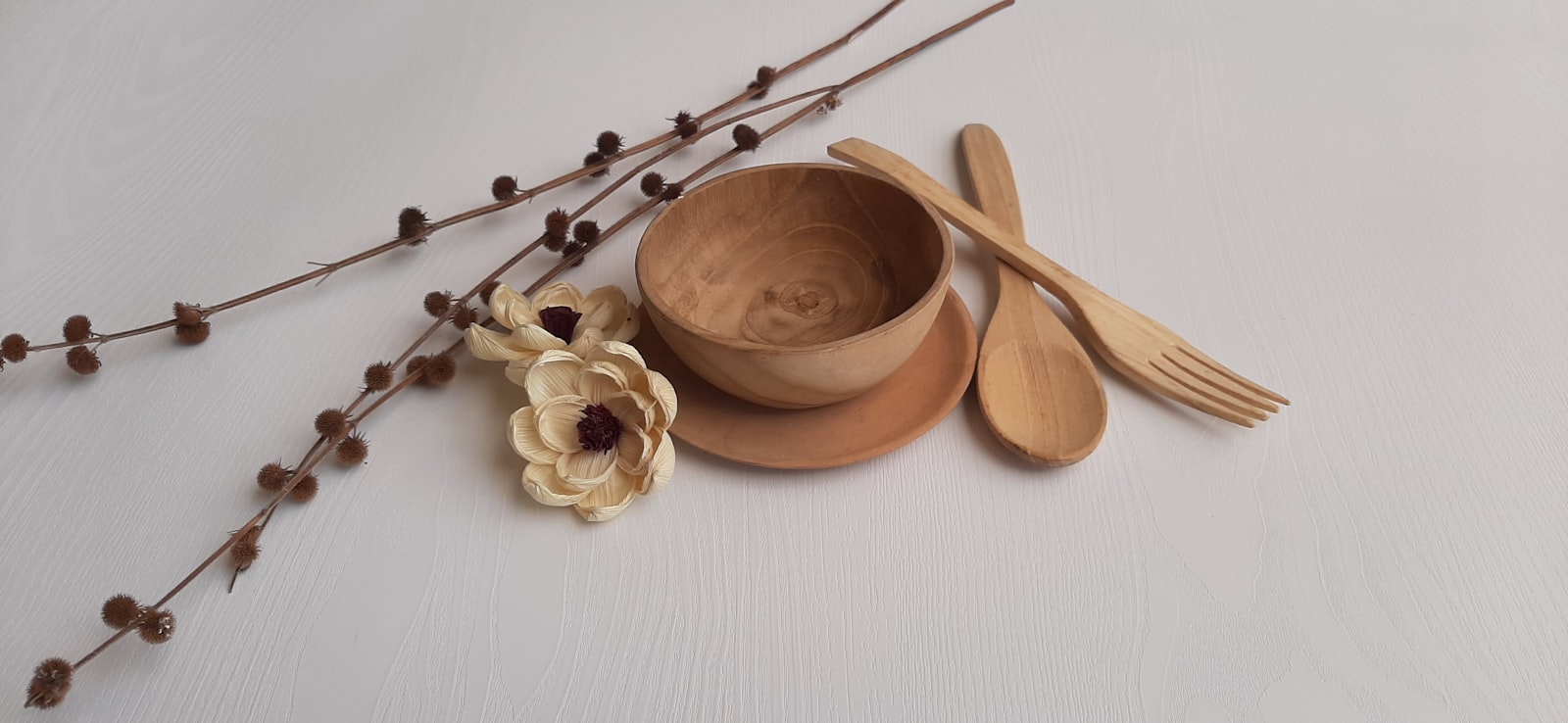
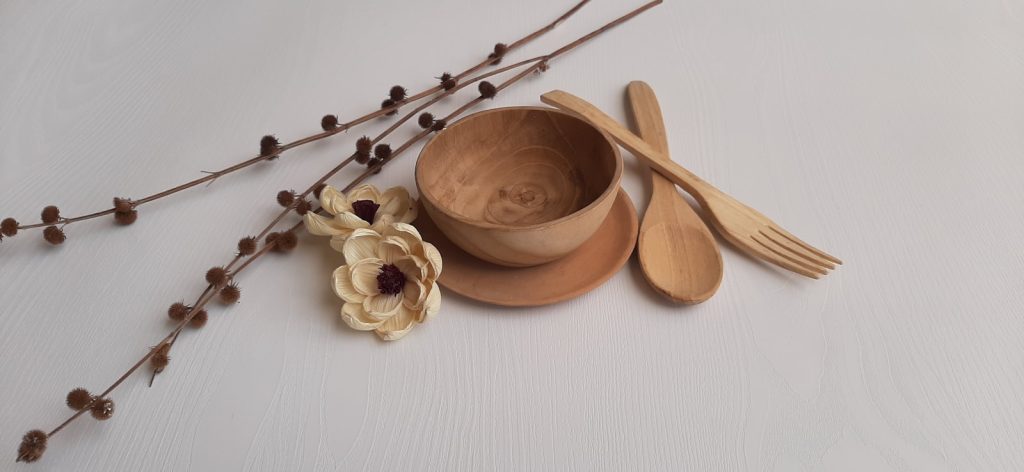
The practical difference from shell for coconut wood cutlery sourcing is form: wood allows deeper spoon profiles, longer handles, and cleaner fork tines than shell can manage. A coconut-wood fork can be carved with tines that actually function for salads and side dishes; a shell fork tends to be more decorative. Coconut-wood cutlery is often what buyers see listed as a full four-piece setting — fork, knife, spoon, and teaspoon — particularly for gift retail programmes.
Finishing coconut-wood cutlery follows the same categories as the bowl: penetrating oil (refined coconut oil, food-grade mineral oil, sometimes beeswax) or a film-forming certified food-contact coating. The wood grain absorbs oil differently from the dense shell surface, so the visual result is different — typically a warmer, more open-grained look under oil. Oil-only finishes on coconut-wood cutlery have the same limitation as on the bowl: washing strips the oil progressively, the surface dulls and may roughen over time, and the buyer or end user needs to re-oil periodically. For cafe service with high daily use, that maintenance requirement is operationally impractical, which is why café buyers who want durability need to specify and verify a certified food-contact film coating — not just accept whatever finish the maker applies by default.
One material to flag specifically: “boiled linseed oil” appears in some workshop finishing guides and is sometimes used as a cost-saving substitute for food-grade oils. It frequently contains metal drier compounds added to accelerate curing, which are not inherently food-safe. Buyers specifying an oil-only finish for export to regulated markets should confirm the exact oil used and its food-grade status, not rely on the general descriptor “natural oil finish.”
Salad Servers and Serving Spoons
Salad servers and larger serving spoons represent the highest-value accessory items per piece. These are carved from coconut-wood rather than shell, because the serving spoon format requires a deeper bowl and a longer handle than shell geometry can provide. A matched salad-server pair — one spoon, one fork — in coconut wood is a popular gift-retail SKU, often positioned as a premium addition to a coconut bowl entertaining set.
For coconut salad servers wholesale buyers, the key sourcing notes are: servers are typically carved by hand from whole sections of palm wood, which means production output per maker per day is lower than for the simpler shell-spoon format. Lead times tend to be longer per unit because of the more detailed carving involved. Matching pairs require consistent grain and tone selection at the sort stage — a pair that looks mismatched in color or finish will fail gift-retail quality expectations even if both pieces are technically correct. Specify that pairs must come from the same batch, with the same finishing sequence, and get that confirmed in writing before placing a larger order.
Food-safety considerations for coconut salad servers are the same framework as everything else in this category: no coconut-wood-specific regulation exists in the US or EU; compliance is demonstrated by composition documentation plus accredited migration test results against the applicable standards. A “food-safe” claim on a server without test documentation is a marketing assertion, not a verified compliance position. Buyers targeting EU food retail — particularly Germany, the Netherlands, or the Scandinavian markets — should request LFGB testing results specifically, since the German standard includes a sensory odour and taste assessment that can fail a product even if chemical migration is within limits.
Bamboo Straws
Bamboo straws are the most structurally distinct item in the coconut-bowl accessories category. They are not coconut-derived at all — they are a separate supply line from Indonesian or Vietnamese bamboo. They appear in coconut-bowl accessory bundles because they fit the eco-tableware positioning and the smoothie-bowl use case. A bamboo straw in a smoothie-bowl gift set is a natural pairing, but buyers should treat it as an entirely separate sourcing conversation from the shell and wood items.
Documented pricing for bamboo straws sits at approximately $0.15–0.34 per piece (supplier-reported, marketplace-sourced — verify this range by pro-forma invoice before any purchasing decision [VERIFY]). That per-piece range is for plain, untreated or lightly treated natural bamboo straws in standard lengths. Treated or coloured straws, or those with decorative etching, will sit at the higher end or above. The per-piece price looks low, but the MOQ logic for straws is often separate from the bowl and cutlery MOQ: a straw supplier may have their own minimum run of 500, 1,000 or 2,000 pieces that has nothing to do with the number of bowls you are ordering. Buying straws through the same maker who supplies your bowls is convenient but not guaranteed — confirm whether your bowl supplier also stocks or can source bamboo straws, or whether you need a separate supplier relationship.
Food-safety considerations for bamboo straws are distinct from the shell and wood items. The critical concern is the inner bore: bamboo dust from the cutting process, residual treatment oils, and any coating or treatment applied to the exterior must not contaminate the interior channel. Straws are by design mouth-contact items — liquid passes through the interior for consumption. Any treatment on the interior must be verified as food-contact safe, and the bore must be confirmed clean and smooth at both ends. A straw that has been tumbled or cut cleanly and left natural is in a reasonably clean position; a straw that has received an interior coating requires the same documentation logic as any coated food-contact surface.
Bamboo straws also add length to a packing carton. A standard straw length of 20–22 cm means the carton cannot be compact in the same way a spoon or fork carton can be. If you are bundling straws into a coconut bowl accessory gift set, confirm the packed dimensions and carton configuration with your supplier before booking container space, because a gift box that accommodates a 22-cm straw will be meaningfully larger and heavier than one that does not.
How Accessory Finishing Differs from the Bowl
The bowl gets most of the attention in coconut-tableware sourcing guides. Accessories deserve their own finish discussion, because the finishing process and the compliance implications diverge in meaningful ways.
Surface Area and Sanding
A coconut shell bowl has a large, relatively open interior surface that a hand-sander or sanding disc can reach in a consistent pass. A coconut-wood spoon or fork has small, confined, curved geometry — the inside curve of the spoon bowl and the undercut between fork tines are both difficult to sand evenly with a machine. Handwork dominates the accessory finishing process even more than it does bowl finishing. That means surface consistency across a production batch is harder to control, and the food-contact surface may receive less uniform sanding than a bowl from the same maker. Buyers who specify food-contact sanding to at least 320–400 grit for their bowl order should apply the same specification explicitly to any cutlery.
Oil Application on a Small Curved Surface
Applying four to five coats of food-grade coconut oil to a spoon is more labour-intensive per unit than coating a bowl, because the spoon geometry requires the maker to rotate and reposition the piece to reach the concave food-contact surface. This is why cutlery finishers often work in batches by dipping rather than hand-rubbing — dipping coats all surfaces simultaneously but may not penetrate the finish into fine carved details as evenly. On a gift-set quality product, hand-rubbing and hand-inspection are the right standards; on a commodity cafe-service spoon, dip-and-wipe finishing is more common. Knowing which process your maker uses helps you calibrate what to expect on sample inspection.
Film Coatings on Cutlery
A film-forming lacquer or certified food-contact polyurethane applied to a spoon has to cure into an intact, non-flaking film on a surface that will be placed in a human mouth repeatedly. Flaking or peeling on a bowl is a quality defect; flaking on a spoon is a food-contamination event. Buyers specifying any film coating on coconut-wood cutlery should request explicit evidence that the coating is a documented food-contact-compliant formulation — not a generic “food-safe” lacquer, which is a marketing descriptor with no regulatory standing — and that the coating has been tested by an accredited laboratory against the applicable standard for their destination market. The cost of that testing is the same order of magnitude as for bowl coatings: LFGB full panel testing runs approximately $450–650 per material type (supplier-reported market figure; verify with your chosen accredited laboratory [VERIFY]).
MOQ Logic for Accessories: Where the Low Numbers Come From
The coconut-bowl accessories category is where the lowest documented minimum order quantities in the whole product range appear. Marketplace listings show MOQs as low as 6 pieces on specific accessory items — a figure confirmed from actual listings, not estimated. That low number is real, but it requires context.
| Accessory Item | Typical MOQ Range | Notes |
|---|---|---|
| Coconut-shell spoons (plain stock) | 6–100 pcs | 6 pcs documented on specific listings; most practical starting point is 50–100 pcs for meaningful quality testing |
| Coconut-wood spoons / forks (plain stock) | 50–150 pcs | Wood carving batch setup drives a higher minimum than simple shell carving |
| Coconut-wood salad servers (paired) | 50–200 pairs | Higher per-pair carving labour; matching pair selection adds a quality step |
| Bamboo straws (plain) | 100–500 pcs (straw supplier) or by bundle | Often a separate supply line with its own minimum; bundled with bowl sets may have different minimums — confirm separately [VERIFY] |
| Any accessory with custom laser logo | 100–300 pcs above plain stock minimum | Engraving setup applies regardless of accessory type; jig setup on small curved surfaces adds time |
| Mixed accessory order (spoons + forks + straws) | Each SKU carries its own minimum; combined total does not automatically pool | Ask explicitly whether the maker allows SKU totals to be combined toward a shared minimum |
A 6-piece minimum on shell spoons is typically the maker’s floor for a sample-equivalent order — it is priced accordingly (the per-unit cost at 6 pieces is substantially higher than at 100 pieces), and courier freight for a tiny parcel from Indonesia can approach the value of the goods themselves. Six pieces is the right format for a quality evaluation, not for a commercial test run. Most buyers who want to pilot coconut shell spoon wholesale orders in a meaningful batch find 50–100 pieces is the practical floor where unit economics begin to make sense.
Which Accessories Pair with Which Bowl SKUs
Matching accessories to specific bowl configurations is a straightforward decision for the basic formats, but there are a few pairing considerations worth flagging before you place an order.
Shell Spoon with Shell Bowl
This is the natural pairing for a smoothie-bowl or acai-cafe format. Both items come from the same material family, so the visual language — the dark, polished interior, the natural organic exterior variation — is consistent. The practical consideration is finish matching: if the bowl carries a particular oil-only finish that gives it a warm matte look, the spoon should carry the same finish specification and ideally come from the same finishing batch. A spoon that has been dipped in a different oil or given a heavier lacquer coat will look different under natural light, and for a gift-retail presentation that inconsistency matters. Specify the finish explicitly in your purchase order and request matched sample pairs before approving a bulk run.
Coconut-Wood Cutlery with Larger Serving Bowls
For a larger-format serving bowl — 14 cm and above — a coconut-wood fork and spoon rather than a shell spoon makes practical sense. The longer handle on coconut-wood cutlery is more proportionate to a larger bowl, and the deeper spoon profile handles rice dishes, grain salads, or tossed greens more effectively than a small shell spoon. This pairing is common in the gift-retail and eco-homeware channels, where a large coconut bowl presented with a coconut-wood salad server is positioned as a serving and entertaining piece rather than a personal smoothie bowl.
Bamboo Straws with Smoothie Bowl Sets
Bamboo straws add the most value in bundle formats aimed at smoothie or acai cafes and at the eco-ecommerce channel. A cafe-service bundle of bowl plus spoon plus straw covers the full service requirement. In a retail gift set, the straw is a value-add that photographs well and is easy to feature in product copy. The straw works less well in a gift retail context where fine presentation matters, because bamboo straws vary in diameter, surface texture, and tone from piece to piece, and they are harder to make look uniform in a high-end gift box than a carved coconut-wood spoon is.
For café buyers specifically: bamboo straws go through more cycles per day than spoons do in a sit-down setting (a smoothie straw goes through one use and should be discarded or washed). The durability question for café straws is therefore different — you want to know whether the straw survives a single cycle in good condition, not whether it lasts months of daily re-oiling. A well-made natural bamboo straw will handle that; a thin-walled or poorly cut straw will split or splinter. Request samples and run a cycle or two before committing to a café volume order.
How Mixing Accessory SKUs Affects MOQ and Packing
A buyer adding multiple accessory types to a coconut bowl programme faces a SKU-mixing question that is worth thinking through before sending the first RFQ.
Most makers who produce both bowls and coconut-wood cutlery treat them as separate production lines. The bowl workshop and the carving workshop may be in the same compound or they may be different artisan groups entirely. Spoons and forks carve on different jigs from the bowl; bamboo straws come from a different facility. When you order bowls plus shell spoons plus bamboo straws in one purchase order, you are asking the exporter to coordinate three production streams, pack them into compatible cartons, and consolidate them for a single shipment.
This is achievable, but it has implications. Each SKU may still carry its own minimum — a shell spoon minimum of 50 pieces alongside a bowl minimum of 100 pieces alongside a straw minimum of 200 pieces are three separate constraints that do not pool. Some exporters with full product ranges will allow combined totals to count toward a shared threshold, but that must be negotiated explicitly, not assumed. Ask specifically: “If I order 100 bowls, 50 spoons, and 100 straws, do the spoons and straws each still have independent minimums, or does the combined order qualify?”
Packing is a practical issue too. Bowls nest compactly in a dedicated carton configuration. Spoons and forks are typically bundled in separate smaller cartons or inner boxes. Straws, given their length, need a carton sized to their length dimension. A mixed-accessory order may require three different carton sizes to be loaded in the same container, which the supplier’s packing plan must account for. Request a carton-by-carton packing list with dimensions before booking freight, not after — a surprise oversized carton for the straw shipment can change your container-fill calculation.
If you want help structuring a mixed-accessory RFQ for a coconut bowl programme, use our enquiry form or reach us on WhatsApp +62 811-3941-4563. We route structured RFQs to vetted Indonesian producers and come back with labelled, sourced figures. No one can pay to change what we publish; if you use our help and proceed with a partner, they may pay us a referral fee at no extra cost to you.
Retail Fit by Channel: Where Each Accessory Sells
Accessories serve different roles in different channels, and the buying brief shifts accordingly.
Cafe Service Utensils
For smoothie bowl and acai cafes, the functional requirements dominate. The spoon must hold up to multiple cycles of use and washing per day. An oil-only finish, which requires periodic re-oiling by the user, is impractical in a service environment — a certified food-contact coating that maintains its surface integrity through repeated hand-washing is more appropriate. The cafe buyer should ask for the specific coating documentation and for any migration test results covering the finish, then make a judgment call about whether the finish meets the relevant food-safety standard for their jurisdiction. Cafes operating in Germany should be particularly careful about LFGB sensory compliance, since even a faint off-odour from an uncured or rancid finish will fail that standard.
Shell spoons in a cafe context should be inspected for rim sharpness — a poorly finished spoon bowl with a rough or thin rim is uncomfortable in the mouth. Specify minimum sanding grit (320–400 for food-contact surfaces) in your purchase order and check this on the sample.
Gift-Set Cutlery
For gift retail, the aesthetic of the accessory matters as much as its function. A coconut-wood salad server pair or a matched coconut-shell spoon set in a kraft gift box is a coherent, photographable product. The buyer’s selection criteria here are visual consistency (matched grain tone on coconut-wood pairs, matched shell colour on shell spoon sets), finish quality (no streaks, no dull patches, consistent sheen), and presentation packaging that protects the pieces in transit to the end customer.
Gift retail buyers tend to order in smaller quantities than cafe service buyers — a 50–150 pair run of salad servers, or a 100-piece run of shell spoons for a seasonal gift set programme. These quantities sit at the lower end of practical MOQ ranges for accessory items, which is where the documentation on minimum order flexibility matters. For a specific volume, request a pro-forma invoice that covers the accessory items separately from any bowls, so you can see the per-unit cost at your target quantity. Gift retail margins need to support a 2.5–3x markup over landed cost; if the per-piece landed cost of a coconut-wood salad server pair is materially higher than your target retail bracket allows, the MOQ conversation with the maker is the first lever to pull.
Eco Ecommerce Add-Ons
Ecommerce brands selling coconut bowls often look at accessories as margin-building add-ons — a spoon pair or a straw added to a bowl listing at a small premium. In this context the accessory needs to be reliable on repeat shipments (consistent quality across multiple orders, not just a strong first sample), it needs to photograph well on a white background, and it ideally carries the same branding as the bowl. A laser-engraved spoon handle matching a laser-engraved bowl exterior is a coherent branded SKU; a plain generic spoon thrown in as an afterthought is not. Private-label accessory sourcing — a coconut spoon OEM with logo — follows the same mechanics as bowl OEM: vector artwork, pre-production sample, MOQ uplift for the engraving setup. Our private-label and OEM guide covers the full branding workflow.
Sourcing Strategy: Accessories as a Bolt-On vs a New Supplier Conversation
A buyer already importing coconut bowls from an established Indonesia relationship has two routes for adding accessories: extend the existing supplier relationship, or open a parallel conversation with a specialist cutlery maker.
Extending the existing relationship is simpler logistically — one purchase order, one shipment, one set of export documents. Most bowl suppliers in Bali and Java do offer companion accessories, either making them in-house or sourcing them from nearby carving workshops. The risk is that a bowl maker’s core competency is bowl finishing, and their accessory quality may not be held to the same standard as their bowls, particularly if the accessories are outsourced. Request samples of the accessories specifically, not just the bowls, before including them in a bulk order from an existing supplier.
A specialist cutlery or coconut-wood carving maker may offer better quality on the accessory side, but adds a second supplier relationship to manage, separate payment, separate lead time, and a separate shipment consolidation. For small volumes — a trial run of 50–100 spoons alongside an existing bowl order — the simplicity argument for the existing supplier usually wins. For a meaningful standalone accessory programme, a specialist conversation is worth the additional logistics overhead.
Bamboo straws are almost always a separate supplier conversation, because they come from a different material and production base. Even makers who stock a comprehensive coconut product range typically source their straws externally. Confirm the straw source, request a separate straw sample, and treat bamboo straws as an independent SKU in your planning regardless of how they appear on the combined invoice.
Quick Reference: Accessory Comparison
- Coconut-shell spoon
- Material: mature coconut shell. Form: short, shallow bowl, compact handle. Finish: same as bowl (oil-only or certified food-contact coating, 320–400 grit sanding). MOQ: as low as 6 pcs documented; practical commercial floor 50–100 pcs. Best fit: smoothie/acai bowl pairing, gift sets, eco retail. Food-safety note: same compliance requirement as bowl finish — request migration test documentation.
- Coconut-wood spoon/fork (single cutlery)
- Material: coconut palm timber, not shell. Form: deeper spoon profile, standard cutlery length. Finish: penetrating oil or certified food-contact coating; grain absorbs differently from shell. MOQ: typically 50–150 pcs per SKU. Best fit: cafe service utensils, retail cutlery sets, serving spoons. Food-safety note: same framework; oil type matters (no boiled linseed with metal driers).
- Coconut-wood salad servers (paired)
- Material: coconut palm timber. Form: large serving spoon plus serving fork, hand-carved. MOQ: typically 50–200 pairs; pair-matching adds a selection step. Best fit: gift retail, homeware, entertaining sets. Sourcing note: pairs must be finish-matched; specify same batch same finishing sequence in contract.
- Bamboo straws
- Material: bamboo — separate supply line, not coconut-derived. Pricing: approximately $0.15–0.34/pc supplier-reported [VERIFY]. MOQ: 100–500 pcs from a straw supplier; confirm if bundling with bowls. Best fit: smoothie bowl café service bundles, eco ecommerce gift sets. Food-safety note: inner bore must be clean, cut ends smooth, any treatment documented and food-safe.
Food Safety Across All Accessory Items: The One Rule
No coconut-shell, coconut-wood, or bamboo-specific food-contact regulation exists in the United States or the European Union. The compliance question is always about the finish applied to the item, not the base material. That rule applies uniformly across every accessory in this guide.
A shell spoon polished with genuine refined coconut oil or food-grade mineral oil is in a comparatively clean compliance position — the oil itself is a food substance, and the surface is essentially oiled natural material. The limitation is durability, not chemistry. A coconut-wood fork coated with a certified food-contact polyurethane, tested and documented to pass migration limits under US FDA 21 CFR or EU Regulation (EC) 1935/2004 and EU 10/2011 where applicable, is also compliant. A coconut-wood server coated with a generic lacquer or a “natural” oil that includes metal driers is neither.
The documentation checklist for any accessory item heading to a regulated market should include: composition disclosure for the coating or finish oil (by technical name and regulatory listing), a third-party migration test report from an accredited laboratory citing applicable standards and simulants, and a signed Declaration of Compliance from the supplier. For buyers targeting German retail or Northern European food-service chains, LFGB testing — which adds a sensory odour and taste assessment on top of chemical migration limits — is the practical benchmark. The cost for LFGB testing runs approximately $450–650 per material type (supplier-reported, verify with your accredited laboratory [VERIFY]). Our food-safe finish and certification guide covers the full regulatory picture for all item types in this category.
Food-safety information here is general background, not compliance advice for your specific product and destination market. Confirm requirements with your own qualified consultant and the relevant destination authority before placing a commercial order.
Frequently Asked Questions
What is the minimum order for coconut shell spoon wholesale?
The lowest documented MOQ for coconut-shell accessory items sits at around 6 pieces on specific marketplace listings, but that quantity is priced and positioned as a sample-equivalent order, not a commercial run. The per-piece cost at 6 pieces is substantially higher than at 50 or 100 pieces, and courier freight from Indonesia for a tiny parcel can rival the value of the goods. For a meaningful quality test, 50–100 pieces is the practical floor; for an order that makes commercial sense on unit economics, 100 pieces and above is where most buyers land. All figures are supplier-reported from marketplace observations — confirm your specific minimum by pro-forma invoice from your maker [VERIFY].
Are coconut wood cutlery and coconut shell spoons the same product?
No. Coconut-shell spoons are carved from the hard shell of the mature coconut — the same material as the bowl. Coconut-wood cutlery is made from the timber of the coconut palm tree trunk and branches. The two materials look and feel different: shell spoons are typically shorter with a shallower spoon bowl and a distinctive dark, polished appearance; coconut-wood cutlery is longer, lighter in tone, with visible grain, and can be carved into deeper spoon profiles and functional fork tines. Both can be food-safe when finished correctly, but confirm with the supplier which material is being quoted, especially since some listings use the terms interchangeably.
Do bamboo straws need separate food-safety documentation from the bowl?
Yes — bamboo straws are a separate supply line, made from a different material, finished differently, and they have their own food-contact requirements. The inner bore of the straw is the critical area: any dust, residual treatment, or interior coating must not contaminate liquid passing through for consumption. Request product-specific documentation for the straw separately from any bowl or cutlery compliance papers. If you are bundling straws into a gift set marketed as food-safe, each component in the set needs its own documentation trail. The straw’s compliance status does not transfer from the bowl’s test reports, and vice versa.
Can I order coconut salad servers wholesale in matched pairs with consistent finish?
Yes, but you need to specify it explicitly in your purchase order. Matched pairs require the maker to select shells or timber sections that are consistent in grain tone and colour at the sort stage, then run both pieces of each pair through the same finishing sequence in the same batch. That matching step adds labour and selection time, which is why salad servers tend to carry a higher MOQ than single-piece spoons. In your spec, state that pairs must come from the same batch with the same finish application and that mismatched pairs are a rejection criterion. Request a matched-pair pre-production sample and keep an approved golden-pair sample on file as the reference for AQL inspection of the bulk shipment.
What is the price of bamboo straws per piece wholesale?
Supplier-reported marketplace figures put bamboo straw pricing at approximately $0.15–0.34 per piece for plain natural bamboo straws in standard lengths, at moderate volumes. This range is supplier-reported from marketplace listings and must be verified by a pro-forma invoice from your actual supplier before any purchase commitment [VERIFY]. Treated, coloured, or decoratively etched straws will sit toward the higher end of that range or above it. Note that bamboo straws often have their own separate minimum order quantity from a straw supplier, independent of any bowl or cutlery order. Confirm whether your bowl supplier also carries straws, or whether you need a separate sourcing relationship for them.
Start Your Accessory Sourcing Brief
Accessory sourcing works best when the brief is specific from the outset: which items, what finish, what volume, what destination market, and whether you need food-contact compliance documentation for that market. A vague “I need coconut spoons” enquiry generates a vague price range back; a brief that specifies item type, material preference (shell vs wood), finish (oil vs certified coating), quantity range, and destination gets you a usable pro-forma quote to compare against.
Our sourcing desk routes qualified accessory RFQs to vetted Indonesian producers and returns labelled, sourced figures — not marketing ranges and no further obligation. Reach us on WhatsApp +62 811-3941-4563 or email [email protected]. Or use our enquiry form with your spec and target quantity in the first message. We respond within one business day, Indonesia time.
For the bundle economics — bowl and spoon sets, 4-piece and 6-piece configurations, and how set pricing differs from accessory-only orders — the coconut bowl and spoon set wholesale guide covers those questions in full. Pricing context for all items sits in the wholesale pricing guide, and MOQ mechanics are detailed in the bulk and MOQ guide.